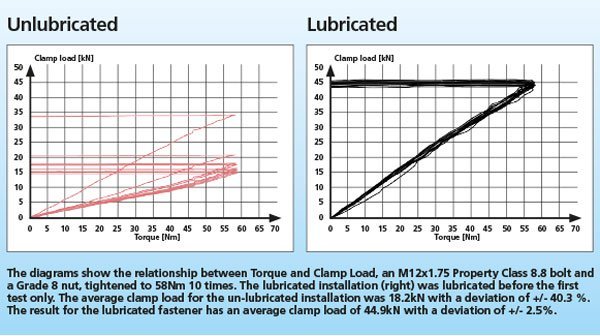
I stole a chart from the folks at nordlock that explains why always lubricating threads give more consistant applied torque as well as increases the applied torque with better lubricity on the thread increases the measured linear applied force to the object being secured.
(So also learn, when dry or wet torque is allowed- always choose wet, it is more consistent)
The average increase in applied force is substantial dry vs wet. The better lubricated one applied more holding power. The more lubricated it is the more slippery the threads.
Imagine if you cover the threads in silica sand and tried it. It would be much harder to turn the torque wrench, even with no clamping force as in before the nut hits the washer. it might take 50lbs of force just to turn the nut before it even touches the washer, so the applied force is far less.
The arp lube compared to motor oil is so slippery that it takes exactly 30% more rotating force to apply the same amount of linear force.
Keep In mind tightening a bolt or nut is like the rear axle in your truck not just changing direction, but has a gear ratio.
Corse threads are like 2.73, and fine is like 4.11.
Think of a rearend that is full of chunky crappy 90 year old gear oil and you are towing 100,000# trailer with your pickup truck and it can only get to 5 mph max. That engine works hard to turn the tires. Now, what happens if you loose the gear oil and the gears get chewed up? The engine was maxed before, same power in engine, but now you only get 1 mph because of the extra work load from the added friction in the gears.
What if, before the gears were damaged, you change the clumpy junk oil with some nasa engineered oil that is crazy slippery? Now you get 6 mph instead of 5 because better lubriation turns a higher percentage of the applied force into actual work.
A good experiment is take a scrap piece of thick plywood- maybe 3/4” thick- but Not a 2x4, the wood grain ruins it.
Put the plywood in a vice.
Drill 3 holes and Use 1/2” bolt and nuts through it with flat washers on only the nut sides, allowing the head of the bolt to sink into the wood.
Leave 1 dry. Use motor oil on one bolt. Use arp lube on the third.
Use your torque wrench and watch how much difference the 3 have squishing the washer into the wood. Do it in steps, 10 lbs at a time.