• Welcome to The Truck Stop! We see you haven't REGISTERED yet.

    Your truck knowledge is missing!
    • Registration is FREE , all we need is your birthday and email. (We don't share ANY data with ANYONE)
    • We have tons of knowledge here for your diesel truck!
    • Post your own topics and reply to existing threads to help others out!
    • NO ADS! The site is fully functional and ad free!
    CLICK HERE TO REGISTER!

    Problems registering? Click here to contact us!

    Already registered, but need a PASSWORD RESET? CLICK HERE TO RESET YOUR PASSWORD!

Possible Engine Build for my 93 Truck

looking at some of the things on this early 6.2 being the rockers and the starter bracket both which seem a lot stronger it would seem like GM put in a lot of effort in designing these diesels in the beginning and then cheaped out on a lot once they were out on the market! Dam those GM bean counters!!
 
I had thought about it this morning of trying something that would help dissolve carbon like some berrymans B12 spray into the intake ports of the head, then using my blow gun in the port while tapping on the valve stem. if it's carbon deposits and they can be cleared that way maybe I won't have to pull the heads right away.
 
That is the original type rocker arm. Yes most of us old dudes prefer that to the button type.
Both type can become “bent” out of the 1.5:1 ratio. It is rare but happens with the intake faster than the exhaust ones. So how we did the check was simply take apart, clean, and use one to make a jig on a work table that had the center shaft hold it, and have a piece of steel tacked in position where the valve would be, and another where the pushrod sits.

Not super accurate but would show when one is out of shape. Usually only one would be, and quite often there was a mark where a valve kissed a piston- so my opinion became it was from that not just time that got it to bend.
Anytime I see valve to piston- everything that moves becomes suspicious & gets checked by measurement-even if just measuring compared to others in the engine.

Do you have an actual leak down tester?
Not hard to diy one & watch couple YouTube videos to see what to do if not. That is your next step imo.

I would fight to use the 6.2 heads over a 6.5 head. I would rather have 6.2 heads rebuilt than buying new 6.5 heads unless it is p400 heads. They simply flow better which is better power, better mpg when you keep your foot out of it, lower egt, better rocker arm system.

 
Don't have a leak down tester, but with all the rockers loosened, the two that had zero compression blowing into the GP hole with my blow gun and rubber tip it all comes out the intake port of the head. the others all have "some" air that goes out the intake ports. the only two that hold really well are the back two on the drivers side. #'s 5 and 7
 
I figured I would go ahead and pull the rockers completely off where I could tap on the valve stem with a hammer. then on the two that have no compression, start blowing in the GP hole and tap, tap, tappity tap on the intake valve. since those two won't even build enough pressure to send the piston down with the air gun. if that works, then work on the rest. and once that is done, re-do the compression test.

I think the valves are where all the compression is going. even on the ones that have semi-good compression (300 psi) I can feel and hear a slight amount of air coming from the intake port. I am sure some is also going out the exhaust too. I haven't pulled the exhaust manifolds off yet.
 
well guys, I made a little discovery. also a little archeology expedition on this engine!! I spent about 30 minutes pulling the rocker shafts off and out of the way. started pressurizing each cylinder and rapping on the valve stems one by one. chunks of carbon started flying out of both the intake ports and the exhaust manifolds, aaannddd I do mean chunks!

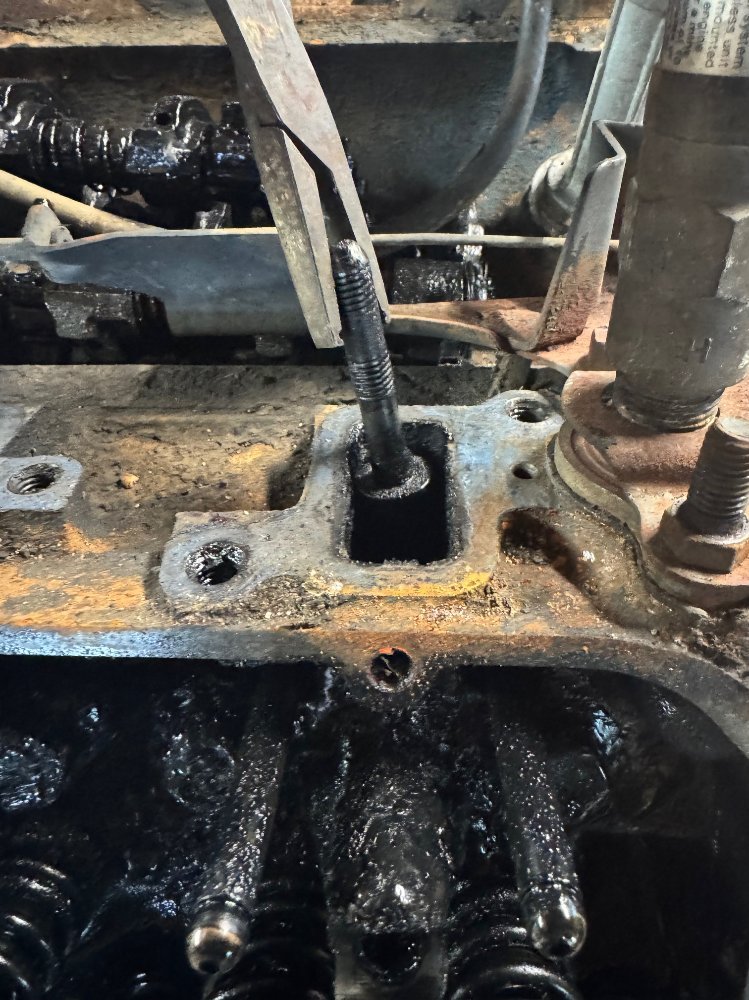
I managed to get #8 to seal up quite well, then I moved on to the others. wasn't able to get the others to seal up quite as well but I still had chunks flying out. Made my way around the engine starting on the passenger side #8 and worked around to end at #7. when I got to #7 on my first rapp I heard a jingle and something pop up from the intake port and fall back down. grabbed my flashlight to have a peek... there was a long bolt that looks like it's been in there for a long while. the head was pointed toward the valve so it didn't actually cause any harm, but I gasped when I saw it.

The threaded end has been rounded and beat up from rattling around in there! (photo below)

is there something that I can use to flood and submerge the cylinders and the ports and let soak that would dissolve and remove a lot of this carbon? I can pour in through the GP holes and fill the intake ports. then let soak for some time, rotate it by hand to expel out the GP holes and try this again?

IMG_1339.jpg
 
Oh yeah, what would have caused all this sludge on the top of the head? there wasn't any sludge in the pan, but all this gummy sludge on top looks like what a gas motor would do, I have never seen sludge build up in a diesel engine! always just a black film.

If I am able to get the valves to seal up without pulling heads, I may roll it out and use some de-greaser and power wash it then blow dry and coat with some wd-40 for rust treatment.

I feel like if I can get the valves to seal up enough to get the compression up to 300 or so, I will be happy with that and run it like it is without a rebuild. if not, then I may have to pull the heads and pull the valves out for a good cleaning and lapping job.
 
1. I really suggest this in its own thread.
2. It is amazing that bolt was in the cylinder with the better compression.
3. Acetone & ATF 50/50. Fill’er up & let it soak a couple days.

With that much sludge- I couldn’t handle it. I would tear the engine all the way down at this point and get everything clean. Cost to get it back to where you are now is a set of head gaskets, set of head bolts, and set of main cap bolts(which many of us had no problems reusing main bolts before).

With that much carbon on the valves- I’m sure you will not have them seal properly. But a tube of lap compound and the suction cup tool would improve them a lot.

I would be willing to bet your valve guide seals are toast in all that sludge. I would invest in those also.

There is lots of tricks for diy work to improve things without incurring machine shop labor.
 
are valve guides something that a machine shop would have to install? your right on that, I really need to pull it down. maybe even talk to the local machine shop about running the heads through their cleaning vat for me. I don't think they would charge much for that.
 
Idk about valve guides yet. But the valve guide seals never survive well with sludge.

If you don’t mind making a mess in your truck bed- get it all torn apart, put block & heads in the bed. Then go to a self service car wash. Simple pressure washing will get it. All a “hot tank” that machine shops have is a device that holds the heads inside and a strong pressure washer with a bunch of heads pointed in different directions and it heats the water up and uses a detergent.
If you’re willing to slip on some overalls and get your boots soaked-or galoshes work great. Wash and flip the parts around till they are clean, and rinse out the bed then wash your truck while there.
Shiny happy engine parts.
 
Funny, I was tired from all this reading on a bank capital review, so I went over to see Wayne at Eagle Watch Automotive and drop off a new transfer case dash switch in case my truck needed it. Wayne was working on a 7.4L Isuzu inline 6 cylinder diesel in a GMC dumper truck. Replacing valve guides that were leaking coolant into the oil. Wayne does it all.
 
RE: Sludge.
BLUF: Heads and rockers are fine and yes, a valve job is in your future but, not because of the sludge.

A few years ago I wasn’t running my engine for more than a few minutes every couple of months (chasing what turned out to be valve issues). I happened to remove the CDR assy and noted that the breather tube was almost plugged with black sludge the consistency of thick pancake batter or loose pudding. Cleaned up easy enough but, alarming. Was informed if the motor isn’t run often and then for only short periods of time like I had to do, temperatures don’t get up where they need to be to drive out moisture that accumulates during those non-running times and the oil sludges upstairs. On inspection of my engine, during tear down, the heads and rockers etc. were still good and could have been reused after an extensive valve job etc. but, long story short, P-400 heads were 10’ away and….
 
Back
Top