From the NHTSA (not NHTSD, sorry) Bold emphasis is mine.
1) What is a bumper?
A bumper is a shield made of steel, aluminum, rubber, or plastic that is mounted on the front and rear of a passenger car. When a low speed collision occurs, the bumper system absorbs the shock to prevent or reduce damage to the car. Some bumpers use energy absorbers or brackets and others are made with a foam cushioning material.
2) What is the purpose of bumpers?
The car bumper is designed to prevent or reduce physical damage to the front and rear ends of passenger motor vehicles in low-speed collisions. Automobile bumpers are not typically designed to be structural components that would significantly contribute to vehicle crashworthiness or occupant protection during front or rear collisions. It is not a safety feature intended to prevent or mitigate injury severity to occupants in the passenger cars. Bumpers are designed to protect the hood, trunk, grille, fuel, exhaust and cooling system as well as safety related equipment such as parking lights, headlamps and taillights in low speed collisions.
3) What are the Federal regulations for bumpers?
49 CFR Part 581, "The bumper standard," prescribes performance requirements for passenger cars in low-speed front and rear collisions. It applies to front and rear bumpers on passenger cars to prevent the damage to the car body and safety related equipment at barrier impact speeds of 2� mph across the full width and 1� mph on the corners.
This is equivalent to a 5 mph crash into a parked vehicle of the same weight. The standard requires protection in the region 16 to 20 inches above the road surface, and the manufacturer can provide the protection by any means it wants. For example, some vehicles do not have a solid bumper across the vehicle, but meet the standard by strategically placed bumper guards and corner guards.
4) Are all vehicle classes required to meet the Federal bumper standard?
No. The Federal bumper standard does not apply to vehicles other than passenger cars (i.e., sport utility vehicles (SUVs), minivans, or pickups trucks). The agency has chosen not to regulate bumper performance or elevation for these vehicle classes because of the potential compromise to the vehicle utility in operating on loading ramps and off road situations.




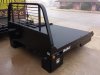
 there are some existing holes on the top side of the rear frame, and (1) 1/4 inch bolt with flatwashers and a lock nut apiece, and they look decent and are held on securely without drilling. the rear mudflap 2x4 is where I have my license plate.