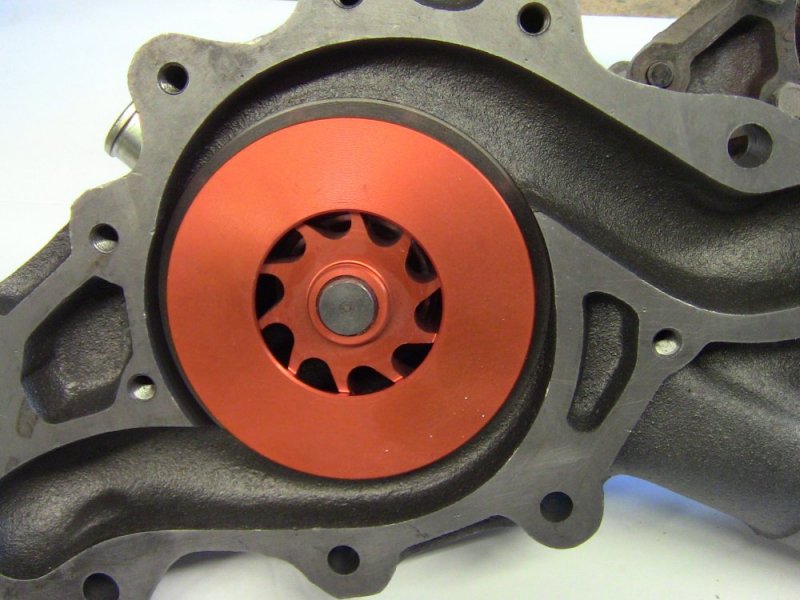
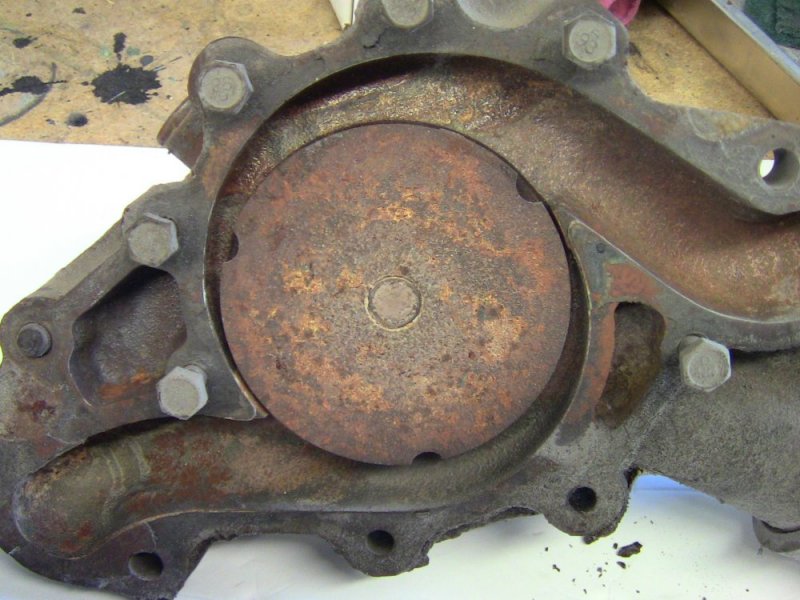
It has to do with the passages and the 1 port or 2 ports of heater hoses.
If you bench test just the large hose input to the pump and the 2 outlet ports to the block, you will get one reading. Then when you bring in the heater hose port(s) it comes into play.
The balance isnt just a case of volume. Temp of incoming fluid and where it feeds out gets affected too.
The driverside heater hose passage is inlet and flow volume alters based on which thermostat crossover is in use. Single stat with block off, and stat closed, it allows alot of incoming hotter fluid to come in and feeds mostly to the driver’s side. Then of course when the stat is open, it stops flow into the waterpump inlet which now allows a greater amount of cooled water into the driver’s side block while forcing all the heated water to the radiator. This is why many people realized better cooling with the single stat block off style than the dual stat when using spin on waterpump.
The passenger side that is tied into the heater core loop is always ran on a continuous flow valve rather than a simple block off at greater expense to build because they needed it to not disrupt the flow pattern.
The two different restrictors that came factory, again were at an added cost to test, engineering, make, and install them. It wasn’t done for marketing and advertising. No salesman talked about them to potential buyers. So why were they there...
The dual stats were created before the spin on pump, and in primary design had two different temp ranges as an attempt to start the redirection of hetaed coolant earlier. The different supplier of the single was out of the running from the death of owner, so gm stayed with the dual stats even after realizing there wasn’t improvements, and it does cost gm to change back and forth between designs. So even though the single block off did perform slightly better once they used the spin on pump, it wasn’t worth it to go back to the old design.
The talk about 1 vs 2 stat causing elevated pressure and blowing out freeze plugs is total nonsense. A 16 lbs radiator cap blows at 16 lbs- silly right? So even if an IMPELLER waterpump could circulate 5,000 gpm - when the stat(s) are closed and there is no outlet anywhere- the pump still is not a POSITIVE DISPLACEMENT pump. I think some dill-hole had rusty steel plugs that finally let loose when he replaced his pump and blamed it on the new monster pump. He then installs new plugs, and the dual stat and everything holds ok- so he wrongly assumes correlation equals causation and the rest is history. There are too many people (me included) that ran the single stat with better results than the dual stats and somehow we didn’t break the rules of physics and blow our plugs out. Haha. Thats on the polite side. Flat out lie to sell extra parts is another theory...
On the testing- we tried just capping the heater hose ports and couldn’t recreate the same testing problems as in a rig. We saw some of the differences, but not all. You need to flow the water through all passages to see it. That’s why the restrictors existed. And the difference of 2 heater cores came in to play a little also.
When the same mfr that made the heater hose fittings that were restrictive who made the single stat went out and AC Delco started making them, they didnt do the restrictor, wether on purpose or mistake. But I know when I worked in the dealership, they pointed that out- it was listed as a possible contributor of issues and had instructions how to replicate a restrictor and install it. Then we had to wait two extra weeks to get paid that 1.2 / 1.3 or what ever it was because it was billed separately to AC Delco as if it were a defective part waiting credit return.
I appreciate you buying and testing this relatively new pump.
If it has enough volume, it is possible any variation of flow through 1 or 2 heater hose ports has no affect.
On the 1 or 2 ports, a question: do all their pumps have 2 ports and trucks, vans, hummers, etc that only use 1 just plug the other port?