Yes, the description above is basically there.
Except doing this inside your house is the stupidest idea I have heard of including Russian roulette, because at least pointing the gun to your own head you recognize you may die. Average person might think this machine is akin to a pressure cooker full of chicken.
This thing is one mistake away from a full on bomb. Plain and simple. If you own acreage and can do this away from your home far enough you would set off a claymore- you are getting almost far enough away. No where near flammable materials. Obviously size of the device matters.
Always clean the plastic of. Food particles, labels, etc are contamination that you don’t want to deal with. Focus on recycling numbers 1,2,4,5. #6 is ok but produces low yield and you use as much energy to convert it as you get out so not worth doing. #3 is pvc- when it brakes down the chlorine in it combines with the loose hydrogen and make hydrochloric acid. Besides just being toxic, it eats your machine quickly. Even if you make a little, that acid damages your engine. So never any pvc. #7 is basically a junk category of plastic that could have mix of the others including the pvc so it is a no go also.
We built our plants with safety in mind over production rate. Because when it catches fire and maybe blows up- that tends to slow production anyways. Not to mention retraining operators to replace the dead and injured ones. Basically you are making a bomb. Plastic is hydrocarbon. Same as oil, diesel, gasoline. So you put it in a sealed vessel, cook it until it vaporizers and is under pressure-See? Bomb. To keep the product from catching fire and burning- the vessel needs to have NO oxygen. ZERO. NADA. Stressed enough? No. but we are moving on, Vacuum pump or nitrogen are both good options.
Moisture is not helpful. When you fracture it you get the loose oxygen molecule messing with other hydro-carbon chains or just allowing a little plastic to burn. So any moisture is a no go.
Pressure
We found 7psi to be our target in the vessel. Watch some YouTube videos of pressure cookers exploding to get a small clue of small container going boom with just air in it. Add the fuel and it gets scary quick. A 25 gallon unit blowing up will absolutely kill anyone within 1 acre. Then those outside the kill zone get to deal with a rain shower of burning oil and fuel everywhere. So all that said we wanted as low pressure as possible. Also higher pressure means you raise the boiling point (think radiator pressure keeps water from boiling) which means more heat required to do the job with no increase in yield.
Boiling plastic into a liquid, then into vapor builds its own pressure. The more heat into the liquid, more pressure. Again think car radiator. But realize you are dealing with extreme heat here.
Water boils at 212° right? So you put 1 cup of water on a piece of metal being kept at 213° and it will boil, Eventually. You add more heat so it happens faster- personally my stove goes full blast until it boils, then add the noodles, and adjust down heat as needed. But in a pyrolysis chamber we need way more than 212°- 535° is melting point... so you want more like 750° to get it rolling. DON’T USE THAT TEMPERATURE as a set figure. Your vessel and plumbing can determine different capabilities.
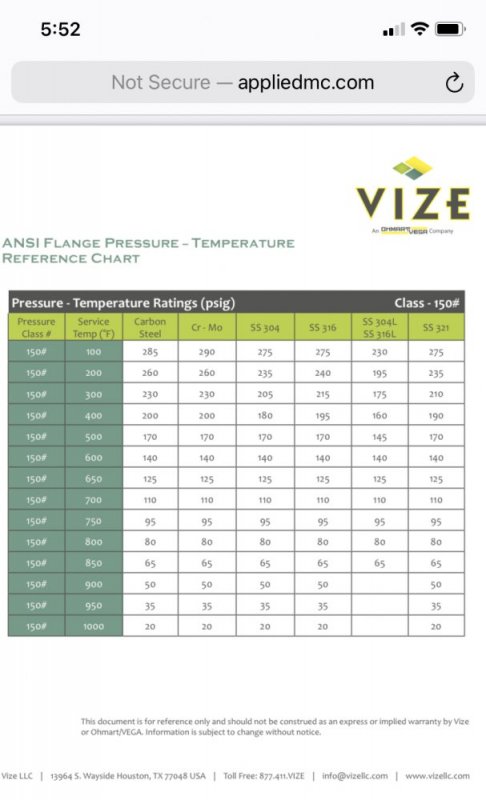
We used SF150 flanges and rated pipe for the plumbing. That 150 meant it is ok up to 150psi. But that is at temperature of 100°. As the temperature goes up, the pressure capacity goes down. And at 1000° it is only good for 20psi. (Chart pic)
Now, I said 750° and 1000° Right? How hot is the bottom of the pot on the stove in the flame? You have to plan with room for error.
Being able to heat the vessel to an exact heat by use of electricity is more accurate to not overheat, but as the material goes away, the temperature will rise. So even with electric you can’t “set it and forget it”


 www.designworldonline.com

 www.machinio.com

