1997 c3500 5.7 - about 6 months ago a vibration would start between 50-55mph, immediately replaced u joints and had driveshaft balanced. After the vibration was still there at 50-55mph I also noticed it around 70mph. Lead me to believe it was the torque converter. Well two days ago lost overdrive for the day, worked fine the next day. Now it decides when it wants to work and when it doesn't. Went to transmission shop to have them scan it and look thru possible sensor issues and find out I have no communication between scanner and truck. Cleaned obd2 port and made sure pins were tight. Unplugged quiet a few sensors one at a time and re scanned still nothing. Went thru all fuses, none were burnt out and all had power. All the wires look perfectly fine. Besides what feels like slow acceleration, the shudder and loss of overdrive the truck runs perfectly fine. All lights work, cigarette lighter works, no check engine lights. Don't wanna throw money at it blindly so the main issue right now is getting connection between scanner and pcm. Any idea of what I'm missing here?

Navigation
Install the app
How to install the app on iOS
Follow along with the video below to see how to install our site as a web app on your home screen.
Note: This feature may not be available in some browsers.
More options
-
Welcome to The Truck Stop! We see you haven't REGISTERED yet.
Your truck knowledge is missing!
- Registration is FREE , all we need is your birthday and email. (We don't share ANY data with ANYONE)
- We have tons of knowledge here for your diesel truck!
- Post your own topics and reply to existing threads to help others out!
- NO ADS! The site is fully functional and ad free!
Problems registering? Click here to contact us!
Already registered, but need a PASSWORD RESET? CLICK HERE TO RESET YOUR PASSWORD!
You are using an out of date browser. It may not display this or other websites correctly.
You should upgrade or use an alternative browser.
You should upgrade or use an alternative browser.

dbrannon79
I'm getting there!
Welcome to the forum @MattP check all of your ground connections, there will be some on the engine block (small wires with eyelets) some on the intake others might be on the inner fenders. get a pinout for your obd2 connector and verify you have power and ground on the correct pins.
as for the vibrations, have you looked at the carrier bearing or sometimes called the center support bearing. it will be mounted on a cross member where the drive shaft separates with a slip joint. also verify the slip joint has been greased too.
as for the vibrations, have you looked at the carrier bearing or sometimes called the center support bearing. it will be mounted on a cross member where the drive shaft separates with a slip joint. also verify the slip joint has been greased too.
dbrannon79
I'm getting there!
What type of scanner was the shop trying to use? GM was sometimes finiky about using different scanners. the Gm Tech2 is almost the only way to go for the GMT400 series trucks.
I'm fairly positive pins are good I had them all out today. Port has power as well. I suppose I can dig deeper on grounds, I only replaced 3 today. As for carrier bearing, I had that replaced the same time as the U-joints. Should add that transmission fluid is clean and has the correct amount. Ill continue on the grounds for now and see if anything changes. Thanks
dbrannon79
I'm getting there!
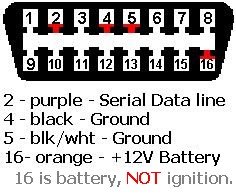
From what I can find both pins 4 and 5 are ground. pin 16 is hot at all times. you can check this with a test light with the key off. connect the test light clamp to a known good positive and then probe pins 4 and 5 to see if it lights up. then ground the clamp and probe pin 16.
if all checks out there might be an issue with the data lines to the ECM or a failing ECM. it's really rare to have an ECM fail but it does happen. you can also check the main connector at the ECM and make sure moisture hasn't gotten into it.
if all checks out there might be an issue with the data lines to the ECM or a failing ECM. it's really rare to have an ECM fail but it does happen. you can also check the main connector at the ECM and make sure moisture hasn't gotten into it.
dbrannon79
I'm getting there!
something else I just thought about. there are a few 5v+ ref signals the ECM sends out to get feedback from the engine and trans. with the key on you can back probe some of these sensors to verify you are getting 5v+ to them with a digital meter. try the simple ones to get to like the TPS, CTS, MAP, Low coolant. I have seen where one sensor gets shorted and it kills that line for the 5v+ and takes out several other sensors with it or can cause the ECM not to communicate. I recall one I had worked on back when I was turning wrenches that simply would not run. it took the entire shop scratching their heads. I found it by accident unplugging the low coolant sensor on the radiator and it fired right up!

Will L.
Well-Known Member
Doug is sending you in a good direction for the electrical- keep following him.
Gonna clarify something- check grounds means disconnect scrub, srape or wire brush until shiny metal then reinstall.
I don’t correlate vibration to the electrical problem unless it is shaking the truck so bad you are loosing an electrical connection. In my mind you have two problems here. One might have caused the other. But I don’t see one item causing both. You could add a boat anchor to the torque converter in one spot and the scanners would still read. With no check engine light, you possibly have a communication issue and it is causing no overdrive. I didn’t stay at a Holiday Inn Express last night, so I might be missing something there- if so someone lmk.
iirc you still get the big boy transmission in yours of the 4l80e with lockup converter. Besides using a scanner to see if tc is locked up or commanding it- you could add a temporary switch to the wire (someone here will have done this and can remind which wire brown or purple) when grounded out will force lock up.
Not sure I would jump on this option right away because we are taking away a safety feature of the trans doing this and not having communication makes it a little more risky. If you don’t fully understand how and when the lockup works do not attempt this without asking details. You should be able to solve the electrical problem without this.
In more accurate check here- you say you lost overdrive. You need to verify you lost OD not just lost tc (torque conver) lock up. You have rpm drop with every gear shift 1-2; 2-3; 3-D; D-OD; OD-tc lockup.
Not knowing differential gears/ oversized tires/ etc. idk speed the shifts happen at.
But get to speed where you should go into OD then manually shift lever into D (aka 3rd gear). If there is no rpm change then yes lost OD. If the rpm jumps then OD is working and you are probably noticing you lost tc lockup.
Onto the vibration side of things-
Get the vibration occurring and note the rpm at each vibration speed. This is useful diagnostics to separate engine and front of trans from rest of truck. Unfortunately you probably didn’t do this before loosing OD. If you had or if you get back OD comparing exact rpm at 70 mph in OD vs Drive tells us which half of the system. Vibrations occur at a harmonic frequency- so it would stay consistent either at the engine and front half of transmission always at same rpm (or multiple rpm but still same ones) or always happen at certain speed regardless of engine rpm if something like tires, driveshaft, differential, etc.
Drive train vibration I check in this order:
Tires. Road force balance not just 99cent tire balance. This will detect out of round and slight bent rim face that normally dynamic balancers will not. If you have another full set of tires like from a buddy’s truck to just swap in for a test drive that’s a freebie.
Engine:
1. the harmonic balancer an have bad rubber ring allowing the outer ring to move.
2. No power steering and in some trucks no power brake WARNING here! With the engine cold remove the serpentine belt, get up to vibration speed quickly to verify it is still there, then pull over and put belt back on. Its ok to run a minute or two without the waterpump but not much longer. If the vibration is still there you eliminates all the engine accessories. If it went away, I have seen power steering pump, water pump, fan, a/c compressor- each individually create a noticeable vibration.
3. Axle issue- another safety WARNING here. differential or axles- I like to put a couple tires without rims against a brick wall then roll the front bumper just barely touching the tires. Jack up rear axle a few inches off the ground. Securely ATTACH jack stands to the frame leaving the axle suspended. Note- this might require some fabrication skills. If I am using a 4 post lift (I will not do this on a 2 post lift) I use semi truck load chain and binder securing the front of the vehicle to the lift. Have a very competent driver bring it up to speed to recreate the vibration while I examine the rear axle assembly.
Sometimes removing the wheels but remembering to run a couple lug nuts down on each side to retain the brake drums/ rear rotors for testing and keeping the parts secure. This allows checking axle run out at the vibration speed- but can alter the strength of the vibration by not having the wheels (mass) to cause the shake.
A far safer version of these tests but less often available is on the ground using floor anchors like a frame straightening system.
Gonna clarify something- check grounds means disconnect scrub, srape or wire brush until shiny metal then reinstall.
I don’t correlate vibration to the electrical problem unless it is shaking the truck so bad you are loosing an electrical connection. In my mind you have two problems here. One might have caused the other. But I don’t see one item causing both. You could add a boat anchor to the torque converter in one spot and the scanners would still read. With no check engine light, you possibly have a communication issue and it is causing no overdrive. I didn’t stay at a Holiday Inn Express last night, so I might be missing something there- if so someone lmk.
iirc you still get the big boy transmission in yours of the 4l80e with lockup converter. Besides using a scanner to see if tc is locked up or commanding it- you could add a temporary switch to the wire (someone here will have done this and can remind which wire brown or purple) when grounded out will force lock up.
Not sure I would jump on this option right away because we are taking away a safety feature of the trans doing this and not having communication makes it a little more risky. If you don’t fully understand how and when the lockup works do not attempt this without asking details. You should be able to solve the electrical problem without this.
In more accurate check here- you say you lost overdrive. You need to verify you lost OD not just lost tc (torque conver) lock up. You have rpm drop with every gear shift 1-2; 2-3; 3-D; D-OD; OD-tc lockup.
Not knowing differential gears/ oversized tires/ etc. idk speed the shifts happen at.
But get to speed where you should go into OD then manually shift lever into D (aka 3rd gear). If there is no rpm change then yes lost OD. If the rpm jumps then OD is working and you are probably noticing you lost tc lockup.
Onto the vibration side of things-
Get the vibration occurring and note the rpm at each vibration speed. This is useful diagnostics to separate engine and front of trans from rest of truck. Unfortunately you probably didn’t do this before loosing OD. If you had or if you get back OD comparing exact rpm at 70 mph in OD vs Drive tells us which half of the system. Vibrations occur at a harmonic frequency- so it would stay consistent either at the engine and front half of transmission always at same rpm (or multiple rpm but still same ones) or always happen at certain speed regardless of engine rpm if something like tires, driveshaft, differential, etc.
Drive train vibration I check in this order:
Tires. Road force balance not just 99cent tire balance. This will detect out of round and slight bent rim face that normally dynamic balancers will not. If you have another full set of tires like from a buddy’s truck to just swap in for a test drive that’s a freebie.
Engine:
1. the harmonic balancer an have bad rubber ring allowing the outer ring to move.
2. No power steering and in some trucks no power brake WARNING here! With the engine cold remove the serpentine belt, get up to vibration speed quickly to verify it is still there, then pull over and put belt back on. Its ok to run a minute or two without the waterpump but not much longer. If the vibration is still there you eliminates all the engine accessories. If it went away, I have seen power steering pump, water pump, fan, a/c compressor- each individually create a noticeable vibration.
3. Axle issue- another safety WARNING here. differential or axles- I like to put a couple tires without rims against a brick wall then roll the front bumper just barely touching the tires. Jack up rear axle a few inches off the ground. Securely ATTACH jack stands to the frame leaving the axle suspended. Note- this might require some fabrication skills. If I am using a 4 post lift (I will not do this on a 2 post lift) I use semi truck load chain and binder securing the front of the vehicle to the lift. Have a very competent driver bring it up to speed to recreate the vibration while I examine the rear axle assembly.
Sometimes removing the wheels but remembering to run a couple lug nuts down on each side to retain the brake drums/ rear rotors for testing and keeping the parts secure. This allows checking axle run out at the vibration speed- but can alter the strength of the vibration by not having the wheels (mass) to cause the shake.
A far safer version of these tests but less often available is on the ground using floor anchors like a frame straightening system.

Paveltolz
Доверяй, но проверяй
For the Scanner communications issue, check for connectivity between port 2 (Serial Data Port-purple wire) and your ECM. P.O. on my 99 had decided the best way to disable the security pass lock was to start hacking at the wiring and had severed that purple wire resulting in my scanner not being able to communicate either.
There's a lot to digest here. Thanks for all the replies, its definitely getting me closer to figuring this all out. Today re-grounded everything and started the truck up and had a check engine light on that wasn't on before. Tried to use scanner but still no communication, check engine light lasted about 3 minutes and went away. Alot of my smaller symptoms lead me to the tps and since its only 40 bucks I threw a new one in. After starting it is when the light came on and went away in 3 minutes. Acceleration feels better but only drove it around the neighborhood since my work trailer and machine is attached at the moment. Will hit interstate tomorrow to see if OD is fine. The vibration definitely happens when truck feels like its about to shift or has begun the process of shifting into overdrive. Only way out of the vibration is let off gas or punch it hard enough to speed thru it (sometimes will shift into OD and sometimes will just rev to 4000rpm) and stay there while trying to keep up with flow of traffic. Main concern right now is the communication, I think I'd have a lot better grip on this situation if I had some codes to go off of. Worth mentioning that the obd2 port has power and grounds in both 4 and 5 as I tested today. Starting to think this is better left to a shop.
dbrannon79
I'm getting there!
Dont probe the sensors with a test light, that can cause unwanted effects. when messing with sensors only use a volt meter.
dbrannon79
I'm getting there!
Just an odd question, but does your truck have anything installed that is aftermarket? stereo, alarm or any modifications done? I think your truck is too young to have a can bus system but was a thought.
I also just recalled messing with an 03 expressvan that had issues with a scanner, turned out to be a faulty ignition switch.
I also just recalled messing with an 03 expressvan that had issues with a scanner, turned out to be a faulty ignition switch.
Yeah it's got an aftermarket radio in it that's it. Radio has never given me issues that I can remember, but today on my way home I realized half of my cluster lights don't work. I remember replacing them to an LED blue when I got the truck and that half has never worked. Wondering if there's some kind of short behind all that. Will probably dig into it tomorrow after work. But yeah the transmission shop said they've seen it being the ignition switch before but the truck shows no symptoms of it being an ignition switch. I'll probably look and see if there's a way to test that.

JMJNet
Recruit
Not solving the scanner communication issue but since you are worried about transmission.
How is the Transmission fluid condition?
Sometimes, transmission problem arises from neglected fluid or even low level.
How is the Transmission fluid condition?
Sometimes, transmission problem arises from neglected fluid or even low level.
Level is spot on, color is nice and red with no debris. Alot of the transmission problems I'm thinking are just sensor related. If I can't figure out communication I wont know which to replace and would probably just throw money at it until its fixed. Still 90% sure I'm dealing with torque converter shudder when it comes to the heavy vibration between 3rd and 4th gear although the instant shudder fix did absolutely nothing. Like I mentioned before I'll try a few more things to get communication otherwise she'll be in a shop.
dbrannon79
I'm getting there!
other than the fluid being bright red, when was the last change? you'd be surprised what you find in the pan and in the filter on some that still look like the fluid is clean. before I changed my 95 trans fluid and filter, it looked clean and didn't have any odd odors. the only reason I changed it was I didn't know when it was last serviced, I pulled the pan and it had a layer of black muck there and the magnet in the pan was a soft jelly like doughnut!
one thing to note is don't use what GM is recommending now. they are saying to use Dex 6 that it supersedes the old Dex 3. others have seen failures with the new fluid. and Dex 3 is somewhat hard to find. Valvoline is one of the only ones who still sells it.
for the OD or the TCC lockup to function there are a few things that will prevent it from happening. things like the TPS, coolant sensor (yours might have two, one for the ECM and one for the gauge), brake light switch (lights will still work and can be bad), and speed sensors and or connections with fluid in them. pull your main harness off the trans and see if there is any trans fluid in the connector.
one thing to note is don't use what GM is recommending now. they are saying to use Dex 6 that it supersedes the old Dex 3. others have seen failures with the new fluid. and Dex 3 is somewhat hard to find. Valvoline is one of the only ones who still sells it.
for the OD or the TCC lockup to function there are a few things that will prevent it from happening. things like the TPS, coolant sensor (yours might have two, one for the ECM and one for the gauge), brake light switch (lights will still work and can be bad), and speed sensors and or connections with fluid in them. pull your main harness off the trans and see if there is any trans fluid in the connector.
Bought the truck November of 2022, only put about 4k miles on it but I have not done any transmission service yet. I might have to try draining and having the filter changed. I have changed the MAF, coolant temp sensor and just yesterday did the tps. Coolant temp sensor completely got rid of my hard start issues. As for tps haven't noticed much of a difference still in and out of OD today. I will try brake light switch tomorrow and possibly get to checking speed sensors. Thanks again ill see what comes of it.
dbrannon79
I'm getting there!
and easy way to check the brake light switch is get it into lockup, then tap the brake slightly without moving your foot off the go pedal while cruising at a constant speed. watch your tach. you should feel and see the TCC release, RPM should increase about 200 or so on the tach.