• Welcome to The Truck Stop! We see you haven't REGISTERED yet.

    Your truck knowledge is missing!
    • Registration is FREE , all we need is your birthday and email. (We don't share ANY data with ANYONE)
    • We have tons of knowledge here for your diesel truck!
    • Post your own topics and reply to existing threads to help others out!
    • NO ADS! The site is fully functional and ad free!
    CLICK HERE TO REGISTER!

    Problems registering? Click here to contact us!

    Already registered, but need a PASSWORD RESET? CLICK HERE TO RESET YOUR PASSWORD!

My son's 1968 Chevy

He has one but it requires a hydraulic clutch. we would have to figure out how to fab up the MC on the firewall for it. when he bought the truck the guy gave him a 5 speed trans and custom cross member that he was going to put in it, but never got that far.

I have read about something from a late 80's S10 would work also which is a T5 where his mechanical clutch linkage would work with it. but those are very hard to find now.
 
I wonder where or who would be able to find out about the TC in that TH400 if it will work with this 250 engine? idk about the low stall but iirc the RPM range is about the same between our beloved diesels and this engine. idle is about 500-600 and top end RPM is 5000 before it claims the dame "comeapart"

I wonder if there is a database somewhere that lists the stall specs for them, I don't think a th400 came factory behind a 250 at all in GM's lineups. I know the th350's did but those didn't come behind a 6.2 diesel!
 
Got the valve cover sealed up using the right stuff. I had a left over can from when I did the valve covers on the 93 but it has dried up in the spout! I was able to easily remove the silicone plug from the spout of the cheese wiz can but couldn't get anything out. ended up poking the bear on that one. shoved a small pointed screw driver in and it all... I mean it all came out LOL. I ended up finger painting a layer of it on the gasket, then had a massive glob of sealant on a piece of card board left over HAHA


I made some changes to the fueling on the ECM and we took it out for a cruise. all seems well other than when you goose the throttle from a dead idle. if you go from idle to wot it will pop and back fire out of the throttle body. I haven't figured that one out yet. played with the timing some thinking that was it, but otherwise putting it under a load going down the road it pulls good. even accelerates in 3rd gear well when you shift too early. before it wouldn't do that at all.
 
I made some changes to the fueling on the ECM and we took it out for a cruise. all seems well other than when you goose the throttle from a dead idle. if you go from idle to wot it will pop and back fire out of the throttle body. I haven't figured that one out yet. played with the timing some thinking that was it, but otherwise putting it under a load going down the road it pulls good. even accelerates in 3rd gear well when you shift too early. before it wouldn't do that at all.
Timing first, then Be sure distributor cap and rotor show no signs of carbon. Blackish looking soot.
Check plug wires with multimeter.
Then try enrichening the fuel just a little.
 
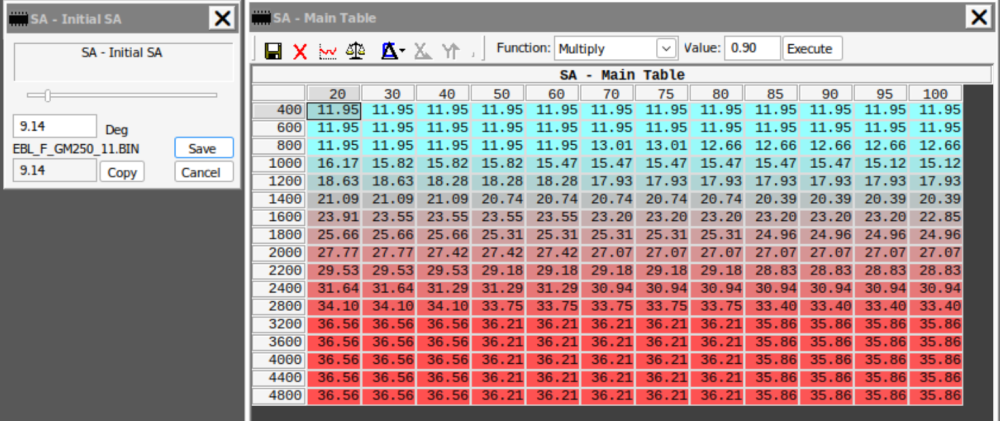
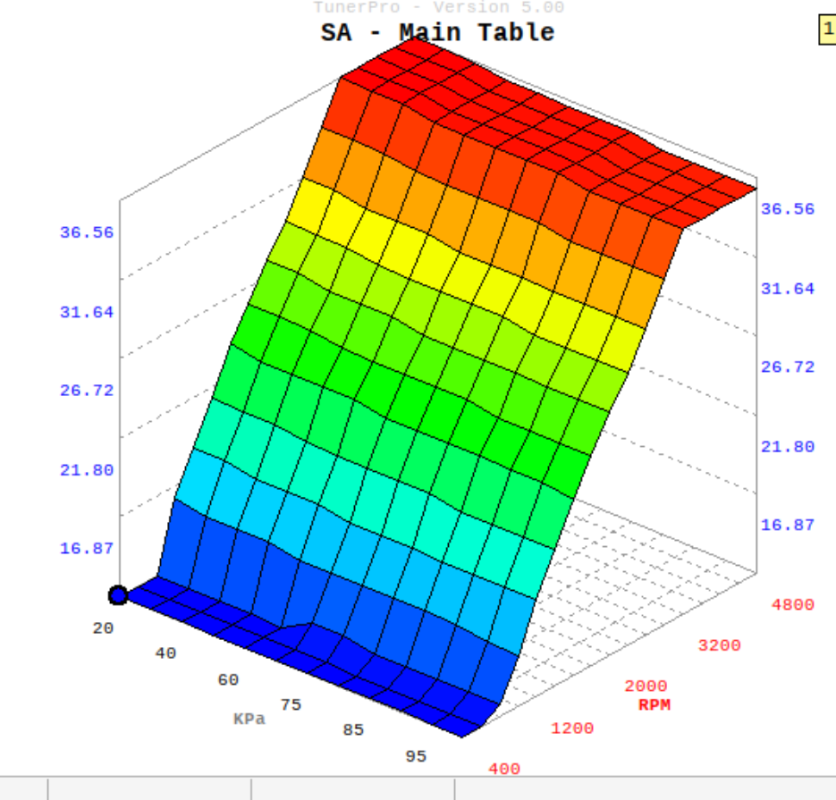
For anyone that has dabbled with OBD1 and 2 and tuner pro for custom tunes here is the current spark advance timing table map and graph for this 250 engine. If someone sees something out of the norm for the spark advance for this engine let me know.

I basically plotted it with the theory behind how a regular vacuum advance HEI distributor would work or at least I tried to picture it in that sense basing the initial base setting (where you set the distributor at) which is 9 degrees for cranking and initial startup and trying to plot a table out on how the timing advance would increase with RPM and vacuum.

This is what I came up with. iirc max advance is set to 36 degrees.

1777943970586.png
1777944009026.png
 
There are variations in the ECM for things like coolant temps and if the knock sensor picks up knocks it retards the timing a bit, but for building a timing table for the ECM is not easy. it's way over my head!

O2 still seems to function and read fine. I see the voltages on the live data rise and fall like it's supposed to. the readout on the laptop shows the air fuel ratio is staying in the 14's. there is no black or blue smoke like there was prior to it having three dead cylinders.

when I had the manifold off I could see the end of the O2 sensor in the pipe and it was clean, no carbon build up and didn't looked torched.
 
The ECM is also no longer reporting any spark knock from the knock sensor other than at crank time. I believe it's hearing the starter. it was explained to me that the knock sensor is basically a microphone mounted to the side of the block and listens for knocking. driving around today it didn't pick up anything other than when you crank it up. the engine is running so smooth it's like a well oiled sewing machine! placing a cup of water on the valve cover and it will stay put, not vibrating off of the valve cover.
 
I also failed to mention that when you rev the engine then let off, during the deceleration you can faintly hear a bu-bu-bump like it's lightly popping from the exhaust on decel. I am sure that also has to do with timing, but does not stumble at all though. other than doing a foot stomp from idle to wot it will back fire through the intake.
 
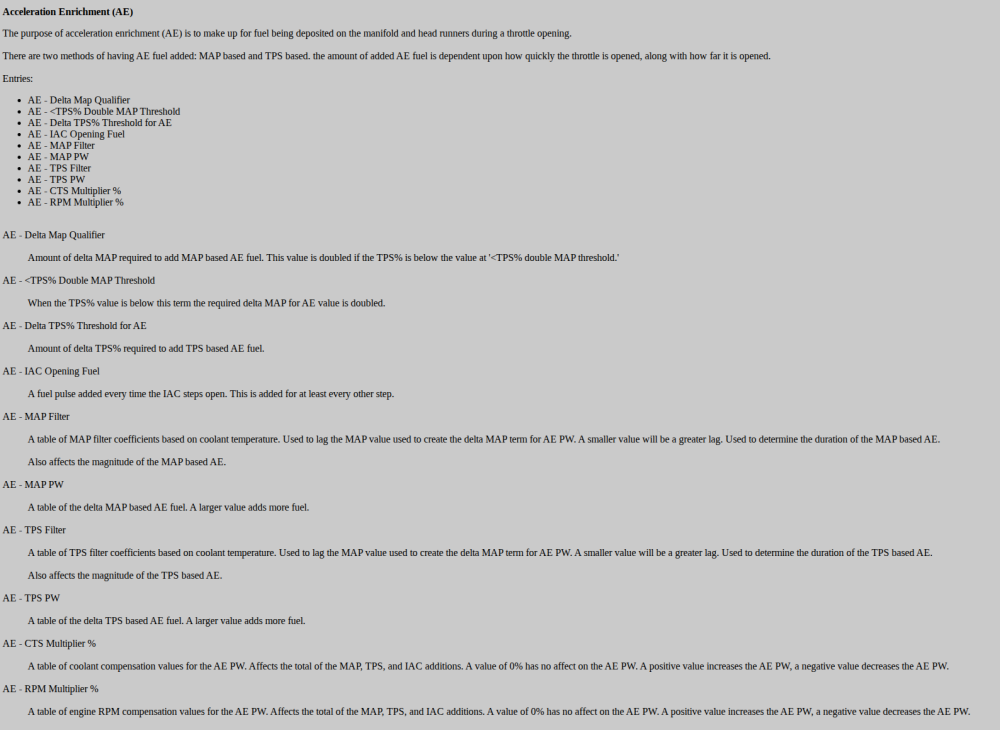
it does. I was just reading the documentation for the ECM. here is a screenshot of the "accelerator pump" settings.

View attachment 99360
I had run several throttle body trucks, they always performed and accelerated wonderfully.
I never give it a thought that they might have an accelerator pump settings built in there too.
 
More documentation coming...

I am compiling all the documents I have for this system that way it will be here available for others in need. some I have saved from the wayback machine since the site is no longer available. I am converting them into pdf documents so I can post them
 

Attachments

The thought just occurred to me about fueling on these OBD1 ECM's (this one is and old OBD1 system modified for on the fly tuning) that they all can compensate for a lean or rich condition to achieve the desired air fuel ratio when all sensors are functioning. they can make slight adjustments by the pulse timing on the injectors to add or take fuel to a point where they reach their limits.

there is one setting I can change which will change the overall fueling rate based on what you tell it per the fuel pressure the injectors are being supplied. This is something I had to play with in the very beginning when we rebuilt the TBI unit and verified what the fuel pressure was from the pump and regulator. I am wondering if I am reaching one of the limits up or down under acceleration because of this now that all 6 cylinders are firing.

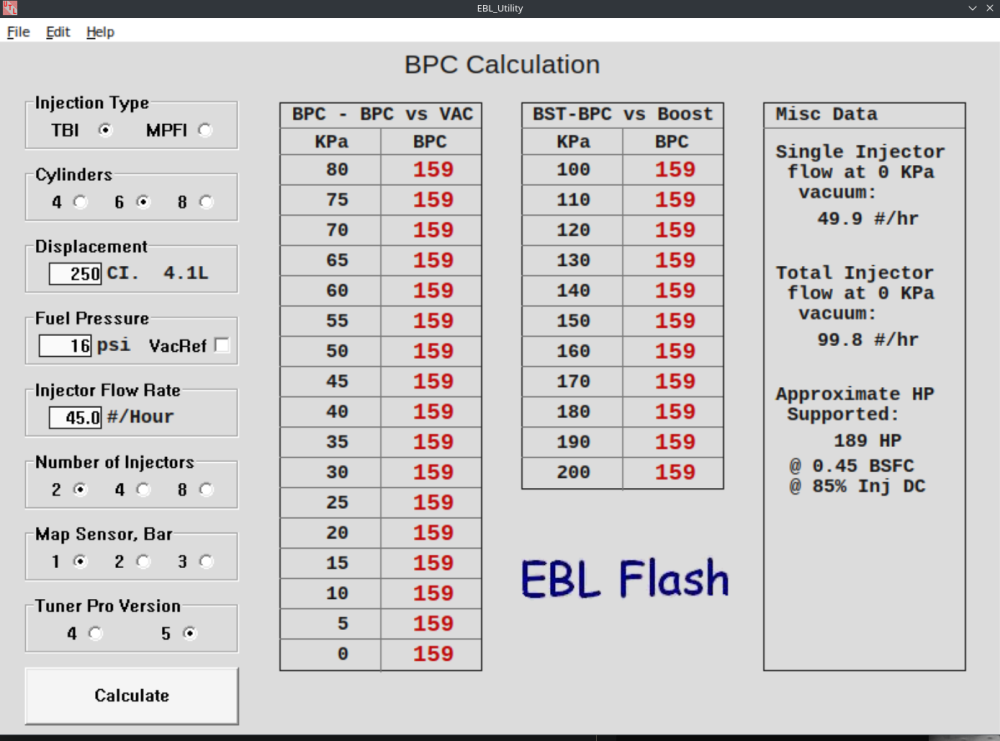
in the initial setup of this system there is a utility I have to run which calculates a table for me based on several factors like injectors, and what the injectors are able to push along with what pressure they are running at. below is a screenshot of the utility. If I run several different calculations and save them to separate files I can keep adding fuel until the engine begins to run rich and can no longer compensate for it (hit it's limit) then go the other way until it begins to run lean. take the middle settings and it should then be able to hit all of its fueling needs in both directions.

I have played with this kind of thing in the past, just not on this system. The second screenshot is what it's currently set at. increasing the numbers will increase overall fueling in all RPM rages including acceleration. simply changing fuel pressure from 16psi to 15.5psi would increase the numbers from 159 to 164 which widens the pulse time on the injectors per each pulse if I understand everything correctly.

The O2 sensor sees the AFR and will adjust the injectors as needed, but only to a point. I might be reaching the the max on the pulse width for the injectors or the limit the ECM can adjust before it hits other constraints.

1777952329364.png

1777952168797.png
 
When it was running extremely rich, I found these numbers in the tune file were up in the 190's though fuel pressure was the same. I have to remember that this tune is based from a GM 4.3l V6 and this is a 4.1 straight 6. iirc the 250 has a larger cylinder bore than the 4.3's and a lot more air flows through this engine too. I am willing to bet this engine will just eat up the fuel and not complain though the MPG's will go down, I don't think they got very good MPG's back in the day even with a carb. I have seen them stock with a 4 barrel holley and even three duces. iirc these engines love fuel!!
 
Making more sense... I redid the calculations but I went online and calculated the engine displacement figure since it was rebuilt and bored .030 over. that actually makes this engine from a 250 to a 258.8ci displacement. just by entering those numbers and leaving the fuel pressure alone gave a number of 164 compared to the 159 it's set at for the BPC.

what I read online quoted by the man himself who created the EBL

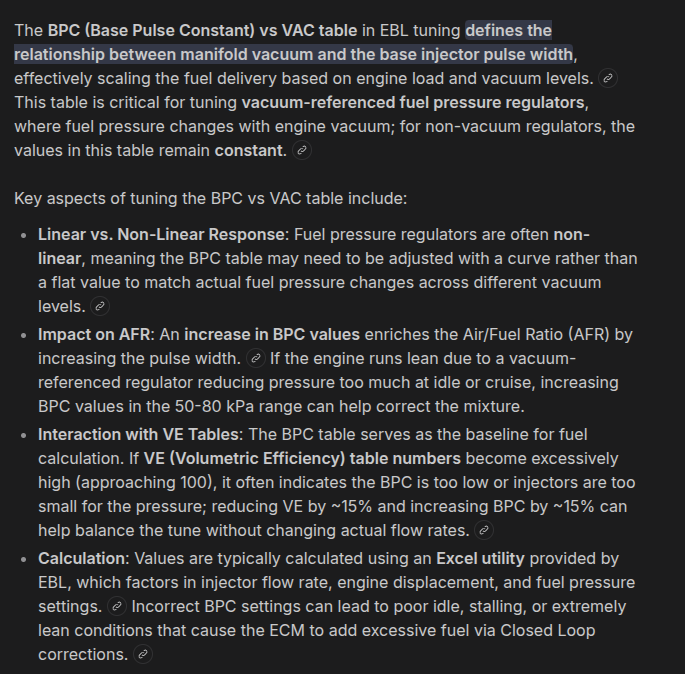
An increase in BPC will enrich the AFR (larger PW). The BPC value is just the injector flow rate and the engine displacement rolled into a single value.


These BPC values are in a table that is based on vacuum. if the fuel pressure changes under load and the BPC number are the same across the table, then things get cattywompus. I need to re-connect the gauge on the fuel supply and watch it under load.
 
Back
Top