Backe in the 1970s we were fold to never weld on the frames. We always had make a bolted connection. Might have just been where I worked
I recall seeing warnings all the time on the big truck frames that says not to weld the frame, I think they are heat treated. I believe that was mainly a warning from the manufacture that was trying to avoid any labilities in case someone welded a frame and it broke into while under load.
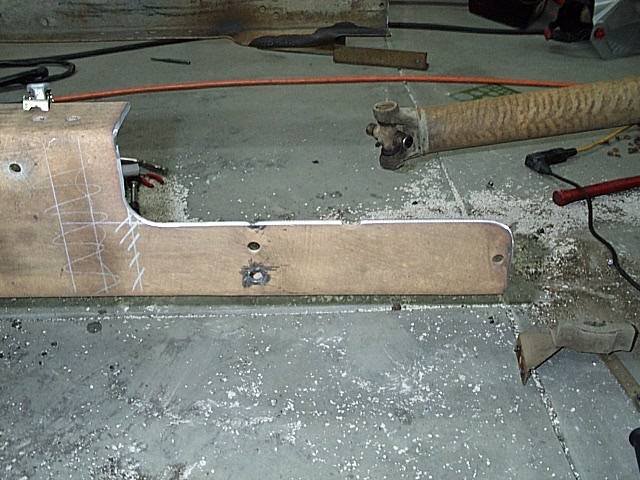
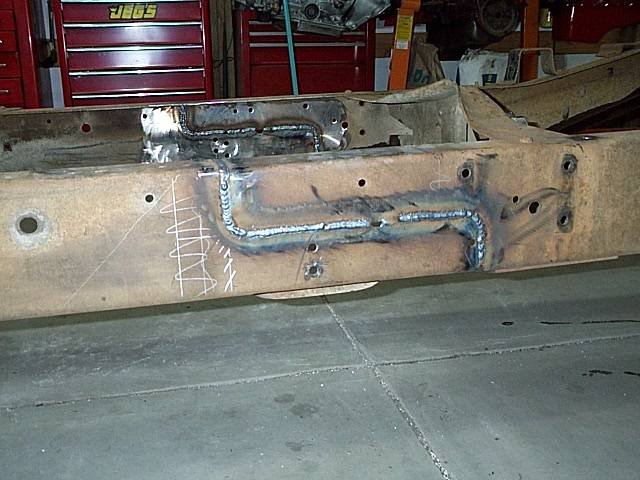
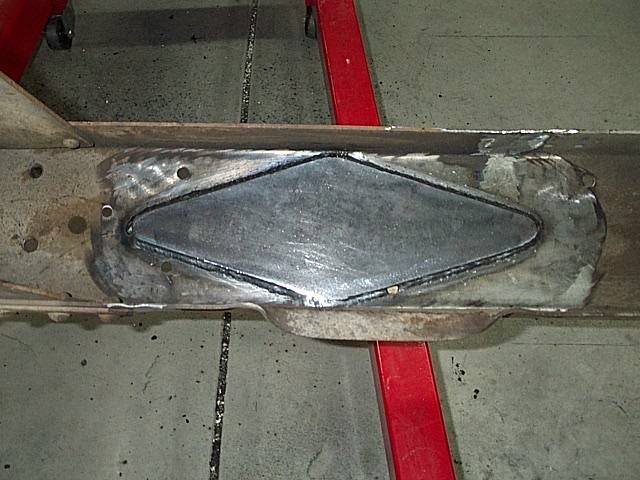
Here is something interesting about welding an International Truck Frame.
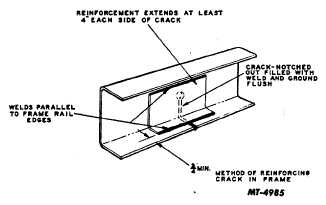
TRUCK SERVICE MANUAL TM 5-4210-230-14&P-1 FRAMES b. Preheat the frame rail along the crack area to 500-600 degrees to burn off excess oil or paint then permit heated area to cool to 200 degrees or below before welding is started. Under no circumstances should the rail be heated to a temperature exceeding 900-950 degrees F. since this is the tempering temperature of the rail. c. Either alternating current or direct current reversed polarity, combined with a short arc and a beading or narrow weave technique may be used.
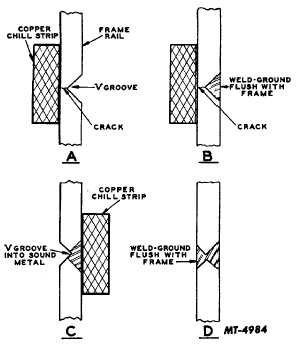
Direct current reversed polarity is recommended or preferred. d. Slag should be removed after each pass and an interpass or constant temperature of 200 degrees should be maintained. e. When sufficient metal has been deposited, the weld bead should be ground flush, Fig. 7, with the surface being repaired. Fig. 7. f. Where both sides of the frame rail are accessible, a V-groove is ground from the side opposite the repair and the procedure outlined above repeated. Dependent upon accessibility, "chill" strips should be used wherever possible. The V-groove ground on the opposite side of the repair should be deep enough to enter the sound metal of the first weld repair "C" of Fig. 7. Frame Welds on heat treated material tend to reduce physical properties in the weld heat-affected zone. Because of this, it is recommended that all reinforcements be designed so that all welds are parallel, rather than perpendicular to the frame rail edges. Welds perpendicular to the flange edges will reduce the carrying capacity of the rail, Fig. 8 and 9. Fig. 8 The edge of the reinforcement flange to the edge of side rail flange dimension should be held to a minimum of three
quarters of an inch to keep the heat-affected zone from extending to the side member flange edge. Wherever possible, it is recommended that plug welds of the type shown in Fig. 9, be substituted for edge welds when assembling the reinforcement to the side rail. Plug welds offer the advantages of a reduced heat-affected zone plus increased flexibility and reduced stress concentrations. When using this method, one half inch (minimum) diameter holes should be drilled and chamfered in the reinforcement on 2" center to center distances. At no time should these holes be drilled in the frame rail being repaired. The reinforcement should then be installed in its proper position on the side member and the holes filled with weld material. Again a minimum dimension of 3/4" should be maintained between the weld and the edge of the side member flange. The voltage, amperage and pre-heat specifications listed below should be followed.
CTS-2037-A Page 6 PRINTED IN UNITED STATES OF AMERICA