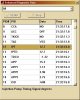
The reason you might be able to get a higher TDCO value by revving the engine and so on could be explained by the IP mod threads. You stepper motor is disabled but changing RPMs changes the IP charge pressure and the differential is what moves the advance piston. The stepper motor controls the differential normally. So when you do this its not the same as actually moving the IP. The difference may be seen if you monitor the actual pump timing, which would show you timing in reference to crank timing. When you move the IP for -1.94 TDCO the actual pump timing will be fixed at about 30.5 degrees, until your desired cam timing goes over 15.25 (which is 30.5 crank degrees). But stepper can bring it below this set timing position up to 22 degrees. When at an IP position of 0 TDCO then the actual pump timing would be like 28.9 degrees. At -0.5 TDCO its like 29.5. If you are fooling the PCM by changing the RPM at which it learns TDCO which changes the differentail IP pressure while stepper is disabled then the PCM really isnt controlling things precisely.
So this TDCO is actually only changing timing from 29.5 to 30.5 crank degrees, which is a difference of 0.5 cam degrees from -0.5 to -1.94 TDCO. In timeset where about 3.5 degrees average is what you will see in the measured/actual timing when set at factory to -0.5 TDCO. But shooting for -1.94 TDCO you move IP and want to get a timeset of 3.8 to 4.0 average.
Also you will never see a screen with a measured/actual timing and a desired timing of 3.5 degrees. You want to see about 3.5 degrees when desired is 0 degrees in timeset. It may also show this in TDCO relearn. The PCM controls timing when operating, and at idle most OBD1 L65 programs I have seen are set at about 9 degrees during normal warm idle. If yours are 12 degrees thats pretty high or has anyone compared what Carcode shows compared to a Tech 2?
So do you get the same benefit from playing with the TDCO value as when moving the IP? I dont know for sure, but Im beginning to think it has nothing to do with timing, but a pressure offset. The timing is the timing according to the crank sensor which has to agree with the cam reference from Optical sensor. When turning the pump it may alter the differential pressures so that it actually alters the fuel metering. And the PCM is probably mapped with the TDCO as a certain modifier to pulse width. If you are just changing the number and not actually moving the pump, you may get some different metering of the fuel, but not the actual pressure change in the IP.
Nothing has really fully explained what the TDCO is, but by looking at the PCM programming and taking into account internal IP pressures incease with RPM, and how things like Optic Bump affect the PCM readings and engine operation the cloud begins to clear on the mystery.
It also seems like a bad practice to shut a computer off in the middle of a procedure like this. I guess that it works with no consequences, but with the scanner its not necessary, and with GMTDScanTech on OBD1 vehicles the software does it.