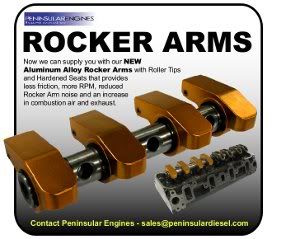
"The rocker arms are Comp Cams magnum roller rockers. They are 1,7:1 ratio big block units. I removed the trunnions in them so I could mount them on shafts. The shafts themselves are made from ground O1 tool steel hardened to 60-62Rc. This hardness is needed so the needle bearings don't brinell the shaft and eventually destroy it. The shaft pedestals are made from 1018 that has been carburized (case hardened) to 60-62Rc for wear resistance (the rockers can rub on the sides of them). They have caps aligned to the bodies with 1/8" dowel pins, and each body/cap pair is numbered and fitted as a pair, similar to rods and their caps. They are mounted to the head using special studs that have 1/2-13 threads on one end and 3/8-24 threads on the other. The studs are machined from 17-4 stainless steel and precipitation hardened to give a strength of 200ksi (for comparison, standard ARP fasteners are 160-170ksi). They are retained with thin walled ARP 12 point nuts. I even had to machine down a socket to fit in the tight well - a standard socket has walls that are too thick. Besides holding the shafts, the mounts also offset them toward the intake side of the heads. This is necessary because the distance between the fulcrum and roller tip is greater with these 1.7 rockers vs. the stock 1.5 rockers. The pushrods are new Sealed Power stock length 6.2 pushrods. Pushrod geometry is identical to a stock engine since the roller tip to rocker ball distance on the big block is nearly identical to the diesel.
Since these rockers are higher ratio the valves gain more lift. Valve lift on a stock 6.2 is .420". With the 1.7 rockers it increases to .476. Piston to valve clearance was checked and, while VERY close, it is better than the specs for the International 6.9. The 6.9 gives an exhaust-to-piston vlearance of only .009"! This is WAY too close IMO, and thankfully the advance built into the 6.2 cams gives around .030". The intake is much tighter, but it can be since the piston is retreating from the valve. Exhaust clearance is much more critical in any engine because the piston is approaching a retreating valve, and any valve float risks a collision. This doesn't happen with the intake valve. BTW, as a point of comparison gassers, especially race motors, try to have at least .100" clearance between the exhaust valve and piston at their closest approach. This is because valve float and lifter pump-up is much more likely with a high revving gas engine."