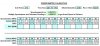
According to my calculations, if you keep the stock offset for the front wheels, you will need very little trimming and probably no suspension changes by going to the 245/70R-19.5 - Wheel offset can make you or break you with any tire/wheel change.
You are going to want to have a minimum of 0.50 inch clearance from rubbing when the wheels are turned to the angle where you get the smallest clearance to any component in the wheel well. Typically the low clearance points are around the bumper valance as well as the plastic fender liner on the LH side around the park brake cable. (check both sides to make sure) You may have to force the park brake cable back and tie it down to the body. Some times it may be necessary to also tie back the plastic fender liner itself. I would use some type of wire tie rather than plastic ties which will eventually stretch and break. Make sure you check your clearances with the truck on the ground with full weight on the suspension. After you make your adjustments, drive it over some bumps to see if you have any dynamic pinch points.
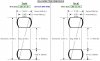
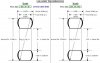
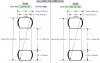
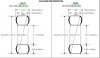
Here is a direct size comparison between the 285/75R-16 vs the 245/70R-19.5 tires.
Note that the unloaded diameter of the 245/70R-19.5 is a little bit taller, but the diagonal, which is what cause the bulk of the rubbing problems when turning, is a little shorter than the 285 tire.
Keep in mind that these figures are NOMINAL dimensions. Different tire makes may slightly deviate from these figures, but these will get you in the ball park. You should always check the tires and wheels mounted on the truck, before you make your final decision.
Let us know what you decide.
Good luck.
PS: don't forget that going to the larger 245/70R-19.5 tires and wheel will cause your speedometer/odometer to read approximately 8.5% too slow. In other words, when the speedometer indicates 60 MPH you'll be going around 65 MPH.