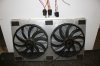
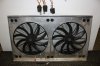
wow this is a great thread! Just wanna say to both Franko and Rob, thank you for your input on your different projects. Rob for your 3" body lift idea and Franko for the P/N's and pictures. Franko for yours those Volvo fans appear to be no more than 2" thick from computer screen. Is this about right?
For an electric fan to do 3000+cfm @18 amps thats very impressive. I'll have to write down these P/N's and info for later use ):h
Hello BigBlueChevy,
The electric fan shroud measures about 1" thick at the edges and gradually increases towards the center. The back of the electric motor sticks out 3" from the surface of the radiator.
I modified the fans to be conjoined in a way that they fit with no clearance in between the radiator's header tanks. Actually, I had to carefully heat one side with a propane torch to soften it enough so it would fit without any pounding/forcing.
I tried to maintain as much airtightness as possible to make the setup as efficient as possible. So efficient, I had to unmask some of the flapper-vent holes at the rear of the shrouds because of the large startup amp draw that would blow the fuses (I blew 5 or 6 before I figured out what the flappers were for).
I chose the twin fan design for redundancy (in case one fails, or fails to activate) and the combined oomph when it is needed.
Because the blades are spinning VERRRY close to the radiator fins, because the blades are of the high speed/high efficiency S-design, and because the shrouds do not allow any "leakage" (i.e., air pulled by the blades come only through the front of the radiator and not from behind), the combined 6,000 cfm rating is inherently "more efficient" (I'm not saying "better" or "just as good as") than the stock setup.
Because of the engine's movements relative to the frame (pitching up and down, and yawing side to side, as examples), there is a pretty large gap between the tips of engine-mounted fan blades and the frame-mounted fan shroud for clearance. Hence, GM engineers over-engineered the fan/clutch setup to compensate for the inefficiencies of the design, i.e., the clearance gap. They had to or tow beasts would be overheating all over the place.
Driving over 35 mph with the fans not activated, the blades are being turned by the air being rammed through the radiator to the point where the permanent magnet motors are generating voltage (the red LEDs I installed to indicate when they are receiving battery/alternator power start to glow and get brighter as the road speed increases).
With the push to drive more fuel-efficient vehicles, an electric cooling fan set up is, really, quite low hanging fruit for very easy picking. Case in point, our 2006 Avalanche (picked up slightly used late summer of 2008) has, virtually, the same setup. At over 7,300 lbs, we get 20 to 21 mpg on the highway with the Flex-fuel 5.3 gasser.
Regards,
Franko